Surviving the Japanese Summer: The Professional Commuter’s Guide to Staying Cool and Protected
Anyone who has experienced July and August in Japan knows that the climate is spectacular but brutally unforgiving. It isn’t just the high numbers on the thermometer; it is the dense, suffocating humidity that transforms a simple walk to the train station into a full-body endurance test.
For business professionals, the daily summer commute presents a unique challenge. You need to navigate crowded train platforms, walking over asphalt that radiates stored heat, all while arriving at your office looking polished, crisp, and completely sweat-free. In a corporate culture that highly values neatness and professionalism, stepping into a morning meeting looking drenched in sweat is something every commuter desperately wants to avoid.
Beating the Japanese summer heat requires more than just willpower. It takes a strategic combination of physiological knowledge, fabric science, and a carefully curated toolkit of cooling essentials.
Here is your comprehensive, professional blueprint to mastering your summer transit in Japan without losing your cool.
Understanding the “Heat Island” Effect on Your Morning Walk
To effectively fight the heat, you first need to understand what you are up against. Urban centers like Tokyo and Osaka suffer heavily from the “urban heat island” effect. Concrete buildings, asphalt roads, and thousands of outdoor air conditioning units trap heat at ground level, creating a microclimate that can feel several degrees hotter than the official weather report indicates.
Furthermore, the humidity prevents your body’s natural cooling mechanism—the evaporation of sweat—from working efficiently. When sweat cannot evaporate into the already moisture-heavy air, your core body temperature rises rapidly, increasing the risk of urban heatstroke (netsuchusho).
Therefore, your defense strategy must focus on two distinct pillars: blocking external thermal radiation and actively accelerating personal evaporation.
Pillar 1: Building the Perfect Shield (Sun Protection)
The first line of defense is preventing the sun’s harsh UV rays and infrared heat from ever making contact with your skin or clothing. Dark business attire naturally absorbs light and converts it into heat, rapidly warming your body. To counter this, you need a mobile shield.
The Architectural Canopy: The Parasol
In Japan, using a parasol is no longer just a fashion statement; it is a vital piece of health equipment for both men and women. Upgrading your daily carry to include a high-performance parasol provides immediate, portable shade that can lower your perceived temperature by several degrees.
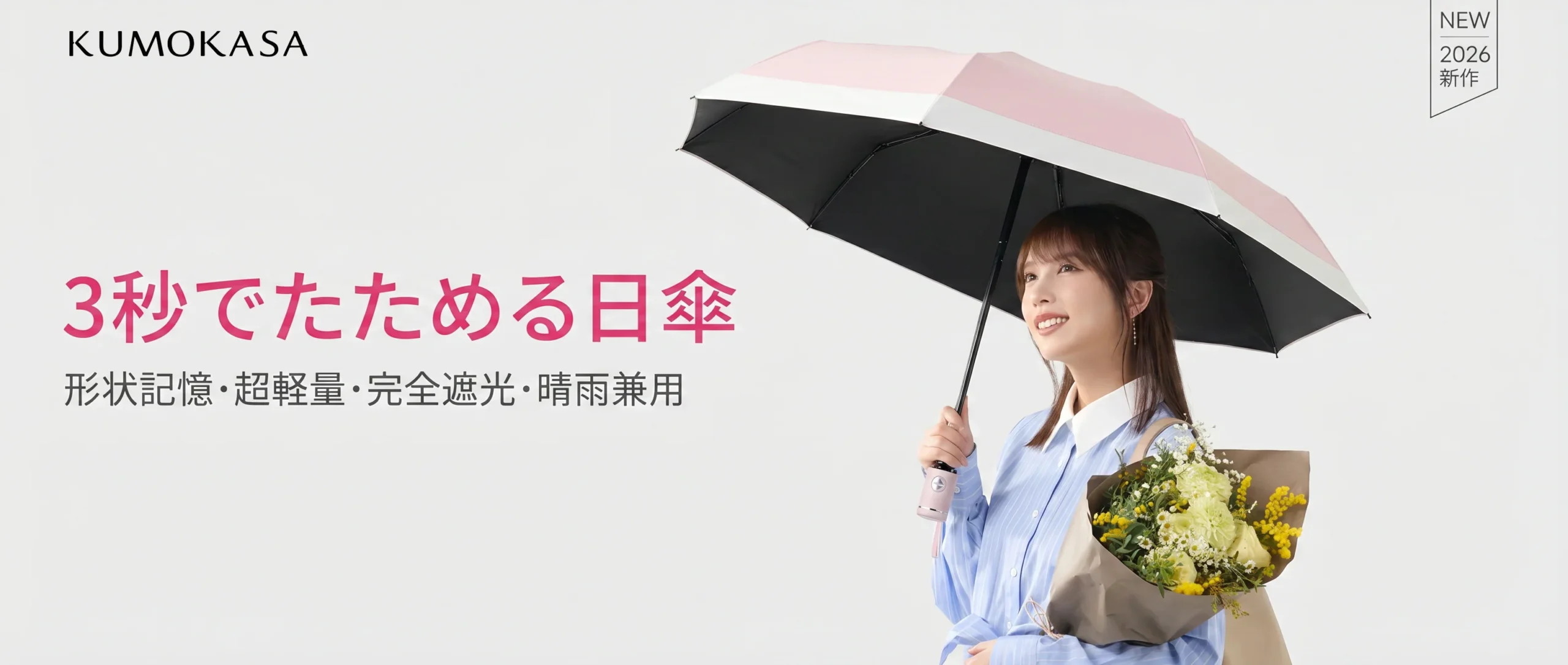
When choosing a parasol for a crowded transit environment, look for options featuring a specialized black heat-shielding inner coating. This layer blocks 100% of UV rays and prevents the harsh glare reflecting off the asphalt from bouncing back onto your face. Opting for a コンパクト折りたたみ日傘 allows you to transition smoothly from a blazing sidewalk to a packed train car without dripping or taking up excess space.
360-Degree Face Defense: The Sun Protection Hat
While a parasol is excellent for open streets, navigating narrow, crowded pathways or stairs near station entrances can make open canopies impractical. For these hands-free scenarios, a dedicated sun protection hat is essential.
Move away from heavy wool or tight cotton caps, which trap heat around your scalp. Instead, select a つば広帽子 made from high-tech, breathable nylon or moisture-wicking linen. Features like built-in mesh ventilation panels allow hot air rising from your head to escape, while a hidden UV-absorbent lining protects your delicate facial skin, eyes, and the back of your neck from premature aging and heat exhaustion.
Pillar 2: Micro-Climate Management (Active Cooling)
Blocking the sun keeps the heat from worsening, but you still need a way to cool down your body while moving through stagnant, humid air on concrete platforms. This requires active micro-climate management.
Forced Evaporation: The Handheld Fan
When the air is completely still, your body becomes surrounded by a thin layer of hot, humid air trapped by your clothes. Breaking this boundary layer is crucial. Carrying a lightweight ハンディファン allows you to artificially create a continuous, refreshing breeze wherever you stand.
Modern portable fans are incredibly quiet and powerful, meaning you can discreetly use them while waiting for your train without disrupting your fellow passengers. For maximum cooling efficiency, don’t just blast air at your face. Aim the airflow directly at your pulse points—such as the sides of your neck or your inner wrists. Because blood vessels are closest to the surface in these areas, cooling the blood here helps lower your overall core body temperature much faster.
The Power of Evaporative Cooling Sheets
Pairing your portable fan with Menthol-infused cooling sheets or body wipes creates an icy, refreshing synergy. Wiping down your neck and arms before turning on your fan accelerates the evaporation illusion, providing instant relief during the peak heat of the afternoon.
The Pro-Commuter Summer Transition Ritual
Mastering the summer commute isn’t just about what you carry; it is about how you execute your transit routine. Implement this three-phase ritual to stay pristine from your front door to your office desk.
Phase 1: The Pre-Cooling Start
Before you even step out of your air-conditioned home, lower your core temperature. Drink a large glass of ice water. Apply your sunscreen at least twenty minutes before walking into the sun so it has time to form a protective bond on your skin. If you wear business shirts, consider spraying a cooling mint body spray onto the inner lining of your clothing fabric for a long-lasting cooling sensation.
Phase 2: The Strategic Station Approach
As you walk to the station, do not rush. Walking at a frantic pace increases your heart rate and triggers an explosion of sweat right when you sit down on the train. Keep a steady, measured stride under the shade of your umbrella.
If your commute involves a transfer, learn the layout of the station. Walk through air-conditioned underground shopping paths or department store basements rather than walking along the burning street level, even if the indoor route takes a minute longer.
Phase 3: The Office Decompression
When you finally arrive at your office building, do not head straight to your desk. Stop by the restroom first. Use a clean hand towel or a cooling wipe to dab away any light moisture from your forehead and neck. Give your body five minutes to adjust to the building’s climate control, smooth down your hair, and step into your workspace feeling composed and ready for the day.
Summary Action Plan for Summer Agility
To ensure you never find yourself stranded on a boiling concrete platform without protection, establish a quick daily checklist before leaving the house:
Check the UV Index: If the index is moderate to high, ensure your sun umbrella is placed in the outer pocket of your bag for instant access.
Charge Your Devices: Ensure your handheld fan is fully charged overnight. Keep a small backup power cable in your desk drawer just in case.
Fabric Audit: Opt for loose-fitting, moisture-wicking undergarments that dry rapidly, allowing your skin to breathe underneath your formal outerwear.
Conclusion: Reclaiming Comfort in the Urban Heat
The Japanese summer is a beautiful season filled with vibrant festivals, evening fireworks, and stunning blue skies. It does not have to be defined by the misery of a sweaty, exhausting morning transit.
By upgrading your daily routine with smart, targeted tools—utilizing a high-performance sun umbrella to block radiation, a breathable sun protection hat for crowded paths, and a handheld fan to keep the air moving—you take complete control over your immediate environment. You transform your commute from a stressful battle against nature into a smooth, comfortable transition, ensuring you arrive at your destination looking as professional and energized as you feel.

Passionate Writer, Blogger and Amazon Affiliate Expert since 2014.